EN
EN

Solve Label Issues and Guide Label Selection
Sep.11.2026
Stable Label Attachment Rate|Solve Label Peeling and Fading Issues, Guide Label Selection
Preview
In the self-adhesive label industry, over 57% of enterprise operational problems stem from improper label selection and mismatched material configurations, including label edge lifting, peeling, fading, and unrecognizable barcodes. Most procurement teams only focus on unit price and printing appearance while ignoring core parameters such as face stock material, adhesive type, and environmental adaptability, resulting in frequent label failures in logistics transportation, low-temperature storage, and high-humidity working scenarios.
In the self-adhesive label industry, over 57% of enterprise operational problems stem from improper label selection and mismatched material configurations, including label edge lifting, peeling, fading, and unrecognizable barcodes. Most procurement teams only focus on unit price and printing appearance while ignoring core parameters such as face stock material, adhesive type, and environmental adaptability, resulting in frequent label failures in logistics transportation, low-temperature storage, and high-humidity working scenarios.

The key to Solving this Problem
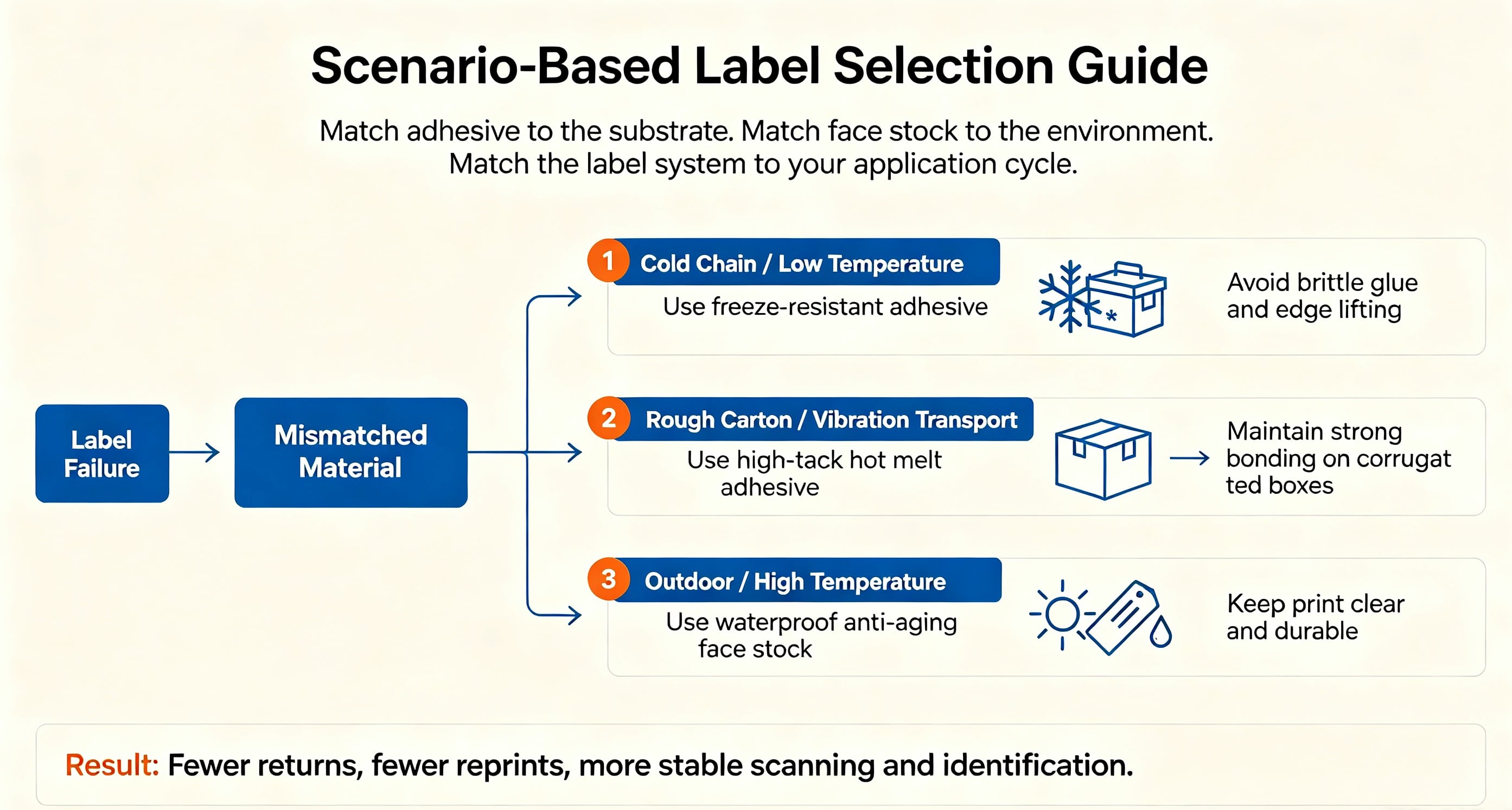
The core of high-quality self-adhesive label application lies in scenario-based matching rather than universal material application. Many enterprises mistakenly use ordinary water-based adhesive labels for cold chain products or common thermal paper for long-term outdoor identification. According to industry data, 35% of label after-sales complaints are caused by mismatched adhesives and materials. For rough carton surfaces, high-viscosity hot melt adhesive is required to ensure firm lamination during stacking and vibration transportation. For low-temperature cold storage environments, special freeze-resistant adhesive can effectively avoid glue brittleness and peeling. For high-temperature and outdoor scenarios, waterproof and anti-aging face stock is essential to maintain long-term clear printing effects.
How to Choose
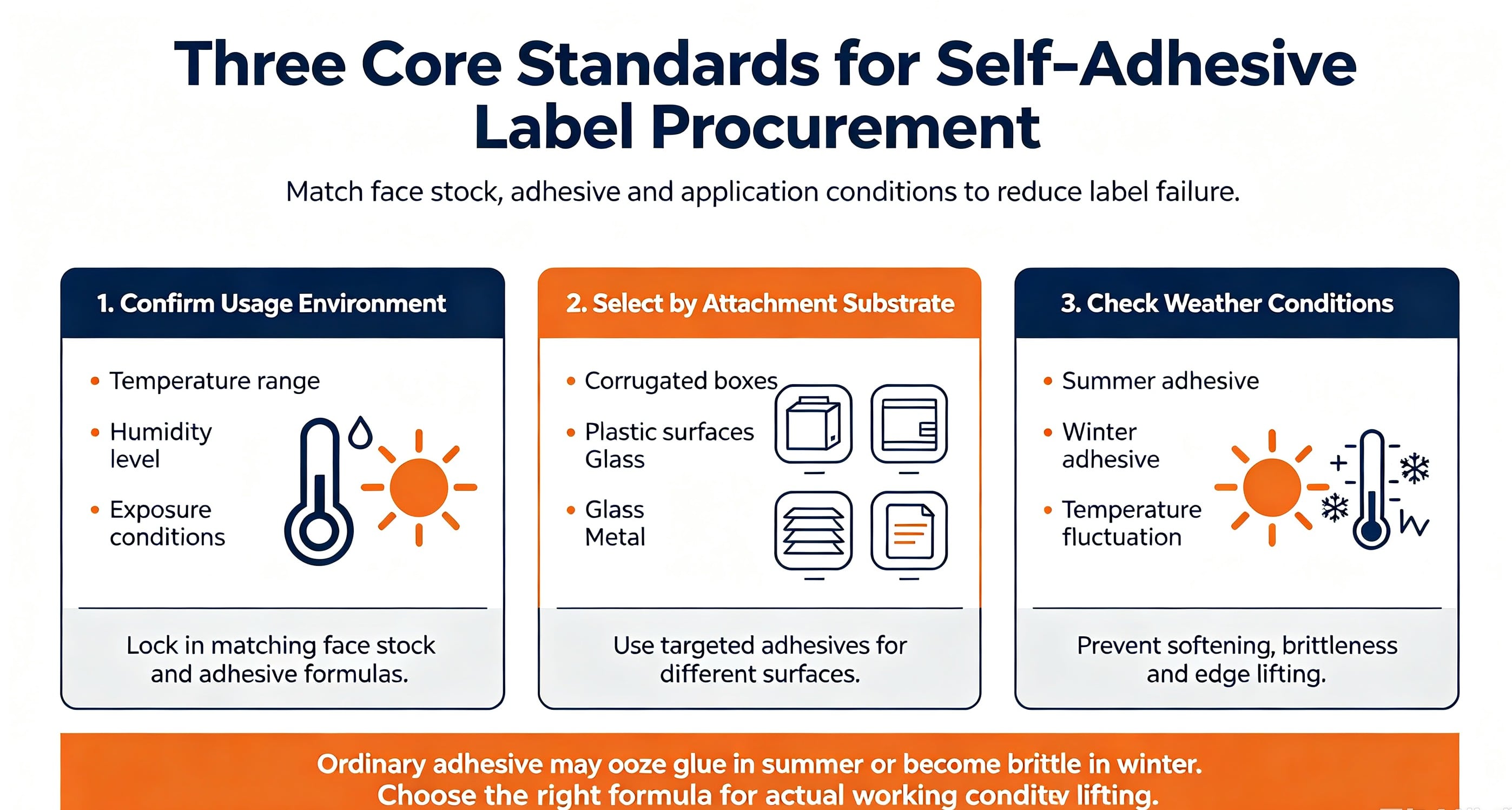
When purchasing self-adhesive labels and jumbo roll raw materials, enterprises need to master three core selection standards to avoid procurement pitfalls.
- Confirm the usage environment parameters including temperature, humidity, and exposure conditions to lock in matching face stock and adhesive formulas.
- Select materials based on attachment substrates, adopting targeted adhesives for corrugated boxes, plastic surfaces, glass, and metal respectively.
- Noticed weather conditions and choose the correct adhesive formula: summer adhesive or winter adhesive. Temperature fluctuation is one of the major triggers for label failure. Ordinary adhesive will turn soft and ooze glue in hot summer environments, or become brittle and lose tack in cold winter warehouses.
- Meanwhile,Check the liner quality of jumbo rolls or finished labels. Stable release force is essential for smooth peeling during mass production. If the release force is too heavy, operators will struggle to peel off labels and may tear the delicate face stock. If it is too light, labels may detach accidentally during storage and transit, resulting in lost product information and extra inventory work. High-quality liner also maintains stable web tension during slitting and die-cutting, reducing web breaks and improving overall production efficiency for label converters.Examine the coating uniformity of adhesive. Uneven glue coating creates inconsistent adhesion across every single label.
- Some areas have weak tack and cause edge lifting after application, while excess glue will bleed out during high-speed die-cutting and stick onto cutting blades. This increases machine cleaning frequency and shortens mould service life. Consistent coating weight across the full jumbo width ensures stable adhesion performance and minimizes batch-to-batch quality differences.Verify printing compatibility of the face stock. Different face stocks are engineered for different printing technologies. Our best-selling direct thermal paper creates crisp, scannable barcodes and clear text without thermal ribbons, greatly cutting end-users’ printing costs and speeding up variable data marking.
- Coated paper and uncoated woodfree writing paper are suitable for thermal transfer printing, producing long-lasting printed marks that resist abrasion. Matching face stock to your printing equipment guarantees reliable printing results for every finished label.Pay attention to the converting runnability of jumbo roll materials. Good runnability means fewer production troubles on high-speed slitting machines. The material should resist stretching, wrinkling and tearing under continuous operation. Premium hot melt adhesive is formulated to prevent glue bleeding, so manufacturers can run longer production runs without machine downtime. Reliable runnability directly raises your factory output and lowers your overall production cost.
Conclusion
Standardized production and strict quality control are improtant. Reliable label manufacturers implement full-process testing on tension uniformity, adhesive coating thickness, and weather resistance of jumbo roll raw materials. The optimized hot melt adhesive formula features strong initial tack, no glue overflow during high-speed die-cutting and slitting, and stable adhesion in conventional working environments, perfectly adapting to automated production lines and mass industrial labeling demands. Meanwhile, compliant environmentally friendly materials meet global food and pharmaceutical safety standards, helping enterprises pass international market audits smoothly.Avoiding blind price competition and focusing on scenario matching and quality stability is the main of reducing enterprise comprehensive costs. If you are troubled by unstable label quality, unclear selection standards, and frequent usage failures, contact our professional solution experts. We provide free customized self-adhesive label and jumbo roll solutions according to your industry scenarios, usage environments, and batch demands, helping you achieve stable labeling and cost optimization.